
.png)

Knowing how to pack a living room for moving is something most people assume will be straightforward — until they are standing in front of a sectional sofa, a wall of framed art, a television mounted above the fireplace, and a collection of decorative items accumulated over years of making a house feel like a home. The living room is one of the most visually impressive rooms in any home, but it is also one of the most deceptively complex to pack. It holds a wide variety of items: large upholstered furniture, fragile electronics, glass-topped tables, lamps with delicate shades, books, throw pillows, area rugs, and artwork of every size and value.
The good news is that a living room can be packed efficiently and safely when you approach it with a clear plan. The key is to declutter before you wrap a single item, gather the right supplies for the specific challenges this room presents, and work through your belongings category by category. This guide walks you through every step of packing a living room for a move — from sorting through accumulated décor to safely protecting your television, disassembling your furniture, and loading the truck in the right order so nothing gets damaged in transit.
The living room is one of the most quietly cluttered rooms in the home. Unlike the basement or a storage closet, the living room looks tidy — but underneath the surface, it holds years of accumulated décor, duplicated throw blankets, books that were read once and shelved indefinitely, and decorative objects that no longer match your taste but have not been replaced. Moving all of it costs truck space, packing time, and unpacking effort at the other end. It also means installing clutter into your new home from the very first day.
Before you pull out a single box or a sheet of packing paper, go through the living room and sort everything into four categories:
Pay particular attention to shelving units and media consoles. These tend to hold the highest density of small, forgotten objects — old game cartridges, outdated cables, instruction manuals for electronics you no longer own, and decorative items that were placed once and never reconsidered. Clear every shelf completely before you begin packing it, and make a deliberate decision about every item rather than boxing it by default.
Be honest about your furniture. The living room often holds pieces that are loved more for familiarity than for function. A sectional that barely fit in your current space will not magically fit better in the next one. If a piece of furniture does not work in your new home's floor plan, now is the right time to part with it rather than paying to move it and then paying again to dispose of it.
The living room requires a more varied packing supply list than almost any other room in the house, because the items it holds are so different from one another in size, weight, material, and fragility. Gathering everything before you start means you will not be stopping mid-session to find materials.
For a typical living room, you will need:
Do not underestimate how much packing paper and bubble wrap a living room consumes. Decorative items are almost always irregularly shaped, and they require more wrapping material per item than the contents of most other rooms.
The best place to begin packing a living room is with the items you use least frequently — decorative objects, books, candles, vases, and accessories that are present for aesthetics rather than daily function. These items can be packed days or even weeks before moving day without disrupting how you live in the space.
Books are heavy and should always go into small boxes. Pack them flat or spine-down to protect the binding, and never fill a small box beyond what you can comfortably lift. If your living room shelves hold DVDs, vinyl records, or video game cases, apply the same rule: small boxes, packed tightly so items do not shift, but never so heavy that the box becomes unsafe to carry.
Wrap every individual decorative item — vases, figurines, candle holders, ceramic pieces, and glass objects — in at least two to three sheets of packing paper. Fragile items should receive an additional layer of bubble wrap. Place heavier items at the bottom of boxes and lighter ones on top. Fill any void space with crumpled packing paper so items cannot shift during transit. Label every box containing fragile items clearly on the top and all four sides.
Throw pillows and blankets are among the easiest items in the living room to pack — and among the most useful as packing material. Use soft blankets and pillows to pad the interior of boxes around fragile items, or pack them in large boxes and use them as a cushioning layer around heavier decorative pieces. Just make sure the box is not so tightly packed that fragile items are being compressed rather than cushioned.
The living room typically holds more electronics than any other room in the home except possibly the home office. A television, a soundbar, a streaming device, a gaming console, speaker systems, and a tangle of power strips and cables all need to be packed in a way that protects them and makes setup at the new home straightforward rather than a frustrating puzzle.
The television is the most valuable and most fragile single item in most living rooms. If you kept the original manufacturer's packaging, use it — it was engineered specifically for this screen's dimensions and weight distribution. If you no longer have the original box, purchase a purpose-built TV moving box in the correct size range. Never lay a flatscreen television flat in a box or on the truck floor. Flat screens should always be transported upright, screen facing inward or protected with foam padding, to prevent pressure from cracking the panel.
Before packing the television, photograph the back of the set and your cable configuration so you can recreate the setup without guesswork. Remove any wall mount hardware carefully and bag the screws and bolts separately, labeling the bag with the mount brand or model if possible.
Pack gaming consoles and streaming devices in their original boxes if available. If not, wrap them thoroughly in bubble wrap and pack them snugly in medium boxes with packing paper filling any void space. Controllers, remotes, and accessories should be individually wrapped and packed together in a clearly labeled box. Bundle cables with twist ties or rubber bands and label each one — even a simple masking tape flag with "TV power" or "soundbar HDMI" will save considerable frustration during setup.
Cables are easy to lose and easy to damage when packed carelessly. Coil each cable loosely (never tightly wound around itself, which can damage internal wiring), secure with a twist tie, and bag cables together in clearly labeled Ziploc bags. Power strips should be wound, secured, and packed in a box where they will not shift or puncture other items.
Lamps, framed art, and mirrors are among the most damage-prone items in any living room. Each requires specific handling to arrive intact.
Disassemble lamps completely before packing. Remove the lampshade first — shades should always be packed alone in a box, nested or positioned so they do not get crushed, never placed under heavier items. Pack lampshades upright with crumpled packing paper supporting the interior. Lamp bases should be wrapped in bubble wrap and placed upright in a box with packing paper filling around them. Remove the bulb entirely and discard or pack it separately; bulbs should never travel in a lamp base.
For smaller framed pieces, wrap the frame in packing paper, add a layer of bubble wrap, and place it in a medium box positioned upright and cushioned on all sides with packing paper. For larger pieces and mirrors, use adjustable mirror and picture boxes — these telescoping boxes allow you to create a custom-fit package that minimizes movement during transit. Write "FRAGILE — DO NOT LAY FLAT" on every side of any box containing glass-covered art or mirrors.
For extremely valuable or irreplaceable artwork, consider whether professional crating services are appropriate. Moving companies that specialize in art and antiques can create custom wooden crates for pieces where standard boxes are not sufficient protection.
Furniture in the living room — sofas, armchairs, coffee tables, side tables, entertainment units, and bookshelves — should be the last thing addressed before moving day, since most of these pieces are in active use until the final days of your time in the home.
Large upholstered pieces cannot be boxed, but they can be protected. Wrap sofas and chairs in furniture moving blankets and then in stretch wrap to hold the blankets in place and protect the fabric from dirt, moisture, and abrasion during loading and transit. Remove all cushions and pack them separately in large boxes or large garbage bags labeled clearly.
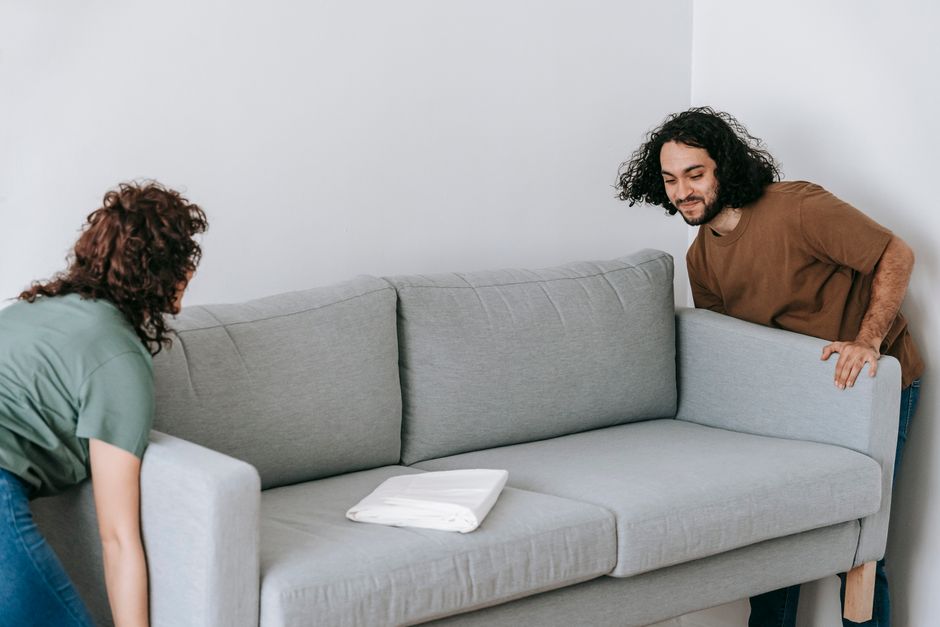
Assess whether any furniture needs to be disassembled to fit through doorways, down staircases, or into the elevator. Sectional sofas almost always separate into individual sections. Sofa legs are typically removable with a simple wrench or Allen key. Removing legs and reversible backs before moving day can prevent both damage to the furniture and damage to the walls and door frames.
Glass-topped tables require the glass top to be removed, wrapped thoroughly in moving blankets and bubble wrap, and transported in a mirror or picture box or fully wrapped upright against the truck wall. Never transport a glass table top flat on the truck floor unless it is fully supported and cannot flex. Wooden table legs should be removed if possible, wrapped in furniture blankets, and rubber-banded or stretch-wrapped together. Label all hardware in a Ziploc bag and tape it directly to the table base.
Bookshelves and entertainment units should be fully emptied before moving — never move a bookshelf with items still on it. Remove shelves if they are not fixed, wrap each shelf in packing paper or moving blankets, and load the unit stripped of all contents.
Roll area rugs tightly rather than folding them, as folding creates permanent creases that are difficult to remove. Secure rolled rugs with rug straps or bungee cords and wrap them in plastic wrap or old moving blankets to keep them clean during transit. Large rugs typically go on the truck last or first depending on your load order, standing vertically along the truck wall.
Packing a living room well is entirely achievable with the right approach and enough time to do it properly. Start early, work category by category, and do not rush the fragile items. A living room packed with care arrives at the new home intact — and a home that arrives intact sets the tone for everything that comes after.
For most households, begin packing non-essential living room items — books, decorative objects, artwork, and accessories — two to three weeks before moving day. Leave the furniture, television, and everyday-use items until the final two to three days. Starting early on the decorative layer prevents last-minute rushing and gives you time to pack fragile items with the care they need.
The safest way to move a flatscreen television is upright, in its original manufacturer's packaging. If you no longer have the original box, purchase a purpose-built TV moving box sized to your screen. Always transport flatscreen TVs vertically — never lying flat — to prevent the panel from cracking under its own weight or from road vibration. Photograph your cable setup before unplugging anything.
It depends on your sofa and your route out of the home. Sectionals almost always need to be separated into individual sections. Sofas with removable legs should have the legs taken off to reduce the risk of damage during tight turns through doorways and stairwells. If your sofa is a single fixed piece and the doorways are wide enough, a professional moving crew can often angle and maneuver it through without disassembly. Measure your doorways and stairwells in advance.
Use adjustable mirror and picture boxes, which telescope to fit the dimensions of your piece. Wrap the piece in packing paper first, then add a layer of bubble wrap before sliding it into the box. Pack framed art and mirrors upright — never flat — and mark every side of the box 'FRAGILE — DO NOT LAY FLAT.' For extremely valuable or oversized pieces, consider professional art crating services.
Yes, with care. Soft items like throw pillows and folded blankets can serve as excellent cushioning around fragile décor pieces inside large boxes. The key is to ensure the fragile items are fully wrapped in packing paper or bubble wrap first, and that the soft items are padding them rather than pressing against unwrapped surfaces. Never pack heavy items on top of fragile ones, even when using soft materials as a buffer.
For most households, begin packing non-essential living room items — books, decorative objects, artwork, and accessories — two to three weeks before moving day. Leave the furniture, television, and everyday-use items until the final two to three days. Starting early on the decorative layer prevents last-minute rushing and gives you time to pack fragile items with the care they need.
The safest way to move a flatscreen television is upright, in its original manufacturer's packaging. If you no longer have the original box, purchase a purpose-built TV moving box sized to your screen. Always transport flatscreen TVs vertically — never lying flat — to prevent the panel from cracking under its own weight or from road vibration. Photograph your cable setup before unplugging anything.
It depends on your sofa and your route out of the home. Sectionals almost always need to be separated into individual sections. Sofas with removable legs should have the legs taken off to reduce the risk of damage during tight turns through doorways and stairwells. If your sofa is a single fixed piece and the doorways are wide enough, a professional moving crew can often angle and maneuver it through without disassembly. Measure your doorways and stairwells in advance.
Use adjustable mirror and picture boxes, which telescope to fit the dimensions of your piece. Wrap the piece in packing paper first, then add a layer of bubble wrap before sliding it into the box. Pack framed art and mirrors upright — never flat — and mark every side of the box 'FRAGILE — DO NOT LAY FLAT.' For extremely valuable or oversized pieces, consider professional art crating services.
Yes, with care. Soft items like throw pillows and folded blankets can serve as excellent cushioning around fragile décor pieces inside large boxes. The key is to ensure the fragile items are fully wrapped in packing paper or bubble wrap first, and that the soft items are padding them rather than pressing against unwrapped surfaces. Never pack heavy items on top of fragile ones, even when using soft materials as a buffer.