



Knowing how to label moving boxes well is the difference between a move-in day where every box lands in the right room and one where you're hauling a "miscellaneous" box up and down three flights of stairs trying to find the coffee maker. A good labeling system does more than name what's inside: it tells the movers where the box goes, how carefully to handle it, and what to unpack first. This guide walks through a labeling method that works whether you're moving yourself or handing boxes off to a moving crew.
The goal isn't a pretty label. It's a system that someone who has never been in your home can read in two seconds and act on correctly, every single time.
The best way to label moving boxes is to mark the destination room, a short contents description, and a handling priority on at least two sides of each box, never just the top. Movers typically carry boxes stacked or at an angle, so a label only on top is often invisible until the box is already set down in the wrong spot.
At minimum, every box should answer three questions at a glance: Where does this go? What's roughly inside? How should it be handled? Skip any of the three and you've created a box that someone has to open just to figure out what to do with it, which slows down the entire unload.
Writing "kitchen" on a box is more useful to a mover than writing "cookware," because the room is what tells them where to physically carry it. Use the same room names consistently across every box, and if you're moving into a home with rooms the movers haven't seen, consider taping a printed floor plan near the front door with each room labeled to match your boxes.
A short phrase like "pots, pans, lids" beats a full inventory. You're not trying to document every item, just giving enough context that you can find things before everything is unpacked, and that movers know to set a box down gently if it mentions glass or electronics.
Color coding moving boxes means assigning one color of tape, marker, or sticker to each room, then applying that color to every box going there. It's faster for movers to scan for a color than to read text on every box, especially during a large move with a full crew carrying boxes at once.
Buy a roll of colored painter's tape or colored dot stickers for each room: blue for the primary bedroom, green for the kitchen, yellow for the office, and so on. Put a strip or sticker on the same corner of every box so the system stays predictable. Tape a matching color swatch to each room's doorway at the new place before moving day. A mover glancing between the box and the doorway doesn't need to read a word to get it right, which keeps the unload moving quickly even with multiple people carrying boxes at once.
If you're also using our packing services in St. George, mention your color system to the crew ahead of time so they can label consistently as they pack, rather than you re-labeling everything afterward.
Fragile boxes need a label that's visible from across the room, not a small sticker in the corner. Write "FRAGILE" in large letters on the top and at least two sides, and add an arrow indicating which way is up if the contents can't be tipped or laid flat.
Beyond the word "fragile," it helps to note the general item inside, like "fragile: dishes" or "fragile: lamp," because that tells a mover how much caution to use. A box of glass ornaments needs gentler handling than a box of hardcover books, even though both might be labeled fragile by habit.
Separate your truly high-priority boxes, passports, medications, chargers, a few days of clothes, into an "open first" category and mark them clearly as different from the rest. These should also be the last boxes loaded onto the truck so they're the first ones off.
If every third box in the house says fragile, movers and helpers start to tune the word out. Reserve it for boxes that genuinely need special handling, and use a plain contents label for everything else. A labeling system only works if people trust what the labels say.
Numbering each box and keeping a master list is the most reliable way to confirm nothing was lost or left behind during a move. Write a number on each box in addition to its room and contents label, then log that number with a brief description in a notebook or phone app as you pack.
This matters most on moves with a lot of boxes or a long gap between loading and unloading, such as a move that involves a stop in storage. When everything arrives, you can check numbers off the list instead of guessing whether a box went missing or just hasn't been found yet.
A simple version: number boxes sequentially by room, like "Kitchen 1 of 12," so you immediately know not just that a box is missing, but how many should be there in the first place.
Avoid vague labels like "misc" or "stuff," labeling only one side of the box, and using a marker that smears or fades, since boxes often sit in a truck or storage unit for days before they're opened. Each of these mistakes creates extra work later, usually at the exact moment you're too tired to deal with it.
If labeling everything yourself feels like one more task on an already long list, our local movers in St George Utah can help coordinate loading and placement based on the system you set up, so the work you put into labeling actually pays off on move-in day. For a bigger move where you're also deciding what to tackle yourself, our guide on DIY moving vs hiring professional movers can help you figure out where to draw that line.
A labeling system doesn't need to be elaborate to work. Pick a method, room names, colors, numbers, or some combination, and apply it consistently from the first box to the last. The ten minutes it takes to label a box properly saves far more time than it costs, especially multiplied across an entire household.
Ready to get your move scheduled? Get a moving quote from Little Man Moves and we'll help you plan a move-in day that goes as smoothly as your labeled boxes suggest it should.
Write the destination room, a short description of the contents, and a handling note like fragile or this side up. Put this on at least two sides of the box so it's visible no matter how the box is stacked or carried.
Do both. Room labels tell movers where to carry the box, while numbers paired with a master inventory list let you confirm every box made it to the new home, especially useful if boxes go through storage.
There's no universal color standard, but bright colors like red or orange stand out best for fragile items. Whatever color you choose, use it only for genuinely fragile boxes so movers keep taking the label seriously.
If you pack your own boxes, labeling is on you. If you use a packing service, the crew typically labels as they go, but it helps to tell them upfront if you want a specific room or color system followed.
Use a marker that won't fade over time, note the general contents and the date packed, and keep a written or digital inventory list separate from the boxes themselves in case a label becomes hard to read later.
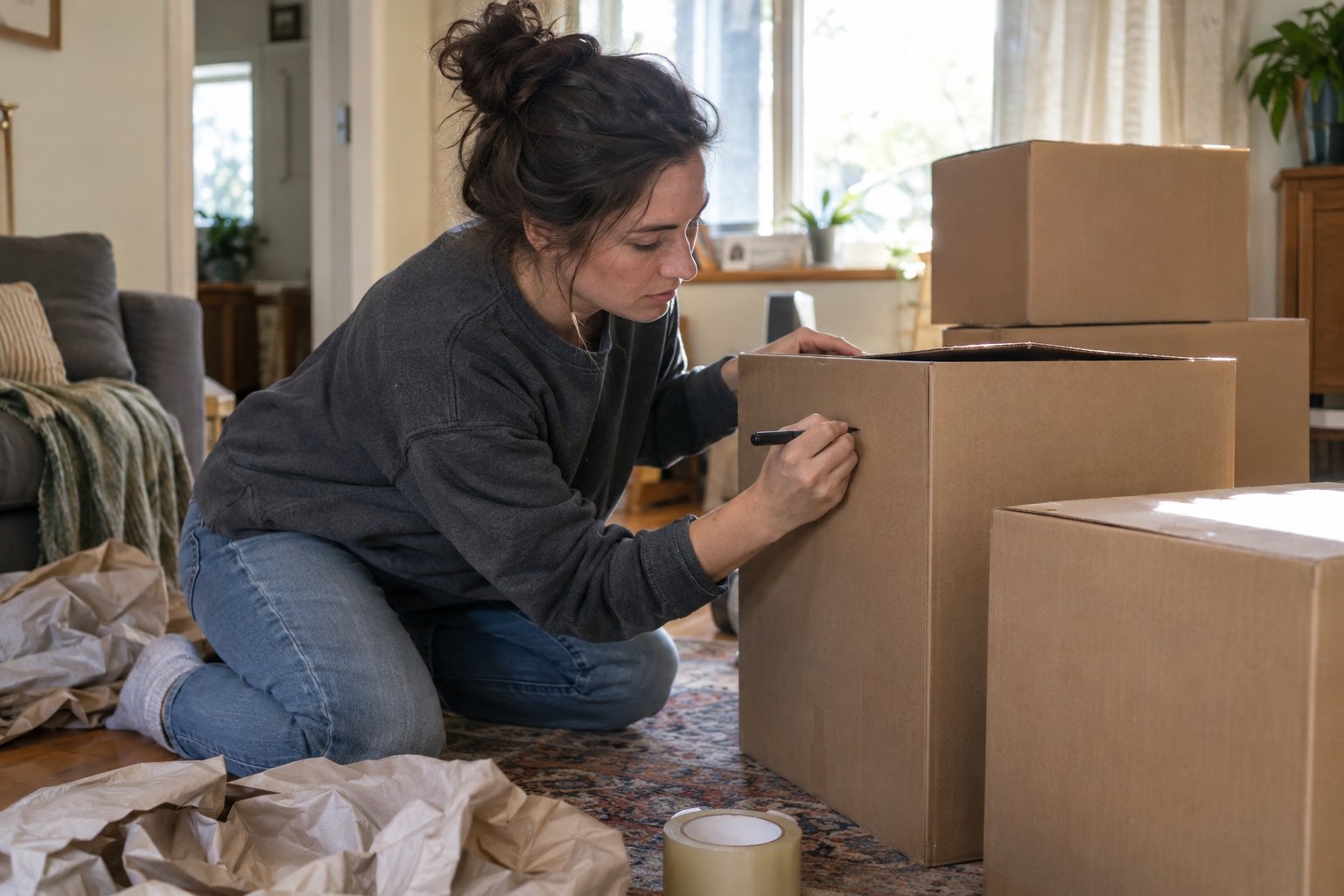
Write the destination room, a short description of the contents, and a handling note like fragile or this side up. Put this on at least two sides of the box so it's visible no matter how the box is stacked or carried.
Do both. Room labels tell movers where to carry the box, while numbers paired with a master inventory list let you confirm every box made it to the new home, especially useful if boxes go through storage.
There's no universal color standard, but bright colors like red or orange stand out best for fragile items. Whatever color you choose, use it only for genuinely fragile boxes so movers keep taking the label seriously.
If you pack your own boxes, labeling is on you. If you use a packing service, the crew typically labels as they go, but it helps to tell them upfront if you want a specific room or color system followed.
Use a marker that won't fade over time, note the general contents and the date packed, and keep a written or digital inventory list separate from the boxes themselves in case a label becomes hard to read later.