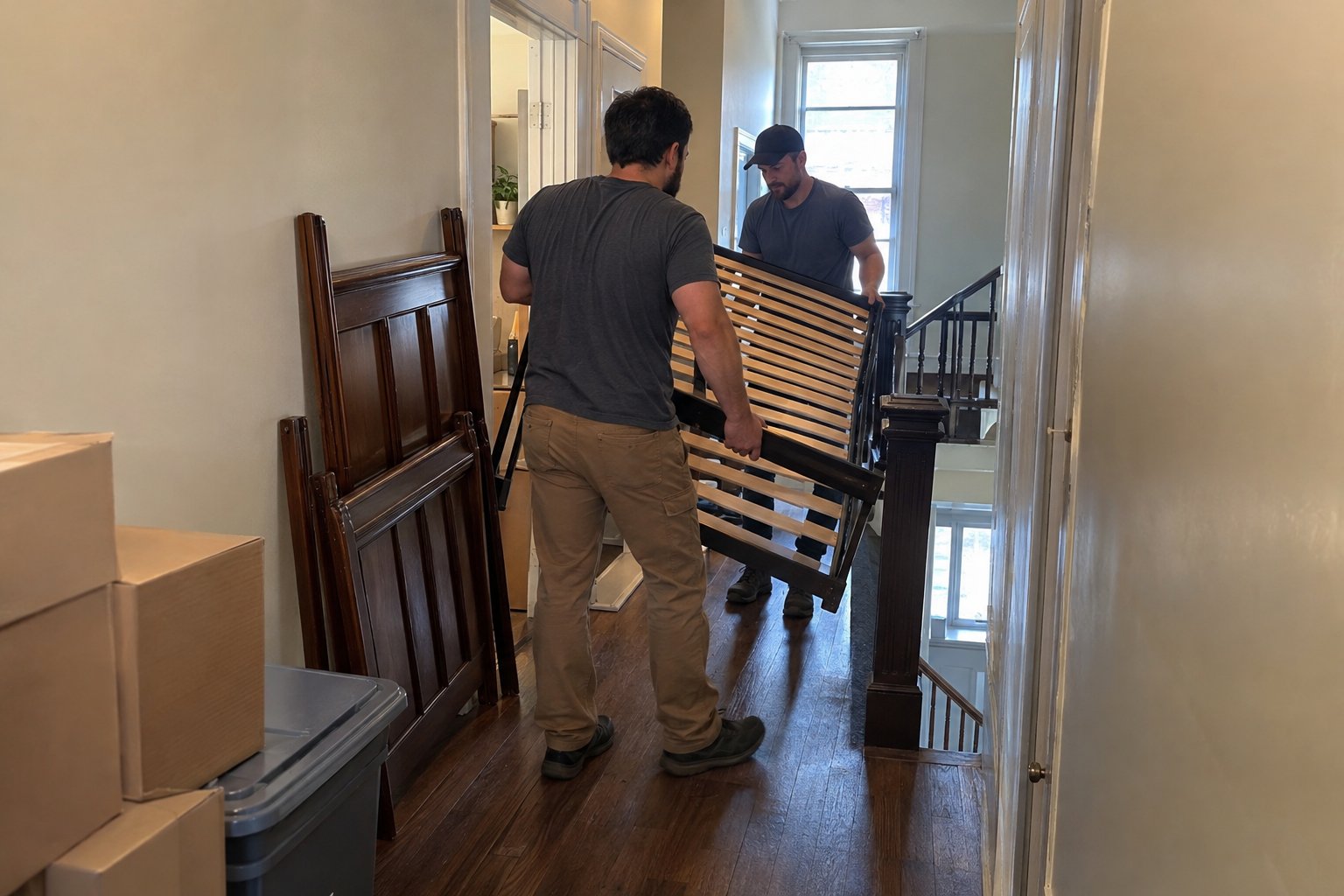



Figuring out how long to book movers for comes down to how much you're moving and how much of it you've already done yourself. A studio apartment with a few boxes and a couch might need two or three hours of help. A full house with a garage, a basement, and furniture in every room usually needs a crew booked for most of the day. Guessing wrong in either direction means either paying for idle time or running out of booked hours before the truck is empty.
This guide compares a short hourly booking against a full-day booking on the things that actually matter: how much time each one buys you, how much effort falls on you, what can go wrong, and which situation fits which approach.
A short hourly booking gets you a crew and a truck for a fixed window, usually two to four hours, aimed at loading or unloading a smaller amount of stuff. A full-day booking reserves a crew for an entire move, from the first box loaded to the last item placed in the new home, with the schedule built around finishing the whole job rather than a set number of hours.
The practical difference shows up in how you prepare. With a short booking, you're often doing some of the packing and staging yourself before the crew arrives, since the clock starts the moment they walk in. With a full-day booking, the crew's schedule has more room to absorb slow spots, like a sectional that needs disassembly or a dresser that won't fit through a doorway on the first try.
The fastest way to estimate is to count rooms, not square footage. As a rough rule of thumb, allow about an hour per room of furniture and boxes for loading, plus a similar amount for unloading at the new place, then add time for stairs, long carries from the truck, or anything oversized. A one-bedroom apartment often lands in the two-to-four-hour range. A three- or four-bedroom house with a garage and a basement is more realistic as a full day.
If you're close to the line between the two, it's worth booking the longer option. Running out of hours mid-move means paying for an extension on short notice, while a crew that finishes early is simply done sooner.
A short hourly booking puts more of the prep work on you, since the crew's time is best spent carrying and loading, not deciding where things go or hunting for missing parts. Having boxes sealed, labeled, and grouped by room before the crew arrives keeps a short window from running out early.
A full-day booking shifts more of that coordination to the crew, especially if you've also arranged packing services to go along with the move. You'll still want a plan for which boxes go where, but the crew has more flexibility to handle setup details like reassembling a bed frame or placing furniture exactly where you want it.
The main risk with a short booking is underestimating the job. If the apartment has more boxes than expected, or the couch doesn't fit through the stairwell on the first attempt, you can run out of booked time before the move is finished. The fix is to book a little more time than your rough estimate, rather than cutting it as close as possible.
The main risk with a full-day booking is the opposite: paying for a crew that finishes with hours to spare because the job was smaller than expected. This matters less if your home genuinely has a lot to move, but it's worth being honest about room count and furniture volume before committing to a full day.
Either way, tell the crew about anything unusual, like a narrow stairwell, a long walk from the parking area, or furniture that needs to come apart, before moving day. A crew that knows what it's walking into can plan the hours better than one that finds out room by room.
A short hourly booking suits a straightforward, smaller move: an apartment, a dorm room, or a house where most items are already boxed and the heavy lifting is the main thing you need help with. It also works well if you just need help loading or unloading a rental truck you're driving yourself.
A full-day booking suits a larger household move, a move where packing still needs to happen alongside loading, or any move where you'd rather not watch a clock while the crew works. If you're moving from a multi-bedroom residential move in St. George, UT, a full day is usually the safer bet even if it means the crew finishes with some time left over.
For most households, a full day booked in advance is the easier path, because it removes the pressure of finishing within a fixed window. If you're confident your move is small (a studio, a one-bedroom, or just a few large items) a short hourly booking through hourly moving help in St. George, UT is a reasonable way to avoid booking more time than you need. When in doubt, describe your home room by room to whoever you're booking with and let them help you size the booking correctly rather than guessing on your own.
Whichever you choose, give the crew an accurate picture of your home ahead of time, including stairs, elevators, or anything in Ivins, UT or Washington, UT that might affect parking or access. The more accurate the picture, the more accurate the hours.
Once you've picked an approach, build your to-do list around it. For a short booking, finish packing before the crew arrives and stage boxes near the entry so the hours go toward loading, not searching. For a full day, you can lean on the crew more, but it still helps to have a plan for where furniture goes in the new home so the day doesn't stall out on decisions.
If you're still working through what to pack and when, a general moving day plan like the one in Moving Day Tips: Tricks for a Smooth and Stress-Free Move pairs well with whichever booking length you settle on. And if your address is changing, don't forget to file a change of address with USPS so mail follows you to the new place regardless of how the move itself goes.
Planning your move? Request a quote from Little Man Moves.
Count your rooms and estimate about an hour per room for loading and a similar amount for unloading, then add extra for stairs or oversized furniture. If that total comes close to a full day, it's safer to book the longer option.
Let them know about stairs, elevators, long carries from parking to the door, and any furniture that needs to be taken apart. The more detail they have in advance, the more accurately they can plan the time.
It depends on the crew's schedule that day, so it's better to book a little extra time upfront if you're unsure. Ask whoever you're booking with how they handle a move that runs past the original window.
No, a full-day booking just removes the pressure of a fixed window, so the crew can take the time needed for things like reassembling furniture or careful placement at the new home.
Have boxes packed, sealed, and grouped near the entry, and clear a path for the crew to move through the home. Finishing this ahead of time keeps the booked hours focused on loading and carrying.
Count your rooms and estimate about an hour per room for loading and a similar amount for unloading, then add extra for stairs or oversized furniture. If that total comes close to a full day, it's safer to book the longer option.
Let them know about stairs, elevators, long carries from parking to the door, and any furniture that needs to be taken apart. The more detail they have in advance, the more accurately they can plan the time.
It depends on the crew's schedule that day, so it's better to book a little extra time upfront if you're unsure. Ask whoever you're booking with how they handle a move that runs past the original window.
No, a full-day booking just removes the pressure of a fixed window, so the crew can take the time needed for things like reassembling furniture or careful placement at the new home.
Have boxes packed, sealed, and grouped near the entry, and clear a path for the crew to move through the home. Finishing this ahead of time keeps the booked hours focused on loading and carrying.